
Iterative Product Development and the Gears That Make It Work
 The Iterative Development Process in Modern Product Development
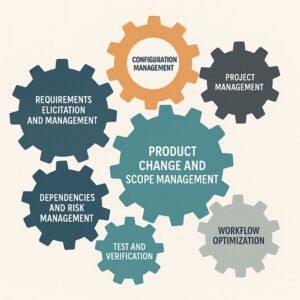
The iterative development process is not a single activity or phase—it is a system of interconnected disciplines working together throughout the product lifecycle. The attached graphic illustrates this system as a set of interlocking gears, each representing a critical capability required to move from concept to successful delivery. Before we go further, we do not believe there is a single approach to doing the work. Context matters, including what is at risk and what we have in assets, resources, and, more importantly, talent. Similarly, there are many ways to get things wrong and fail.
If you’ve spent any time with our writing, you’ll notice a common thread: product development. It’s the space we live in—spanning everything from early concepts and patents (seven granted so far, with another on the way) through launch, lifecycle management, and product retirement. Along the way, we’ve built depth through hands-on experience, formal training, certifications, and advanced degrees. What keeps us engaged is simple: product development is never static. There is always more to learn, refine, and improve—and that continuous learning is where real value is created.
When one gear stalls, the entire system slows. When all gears move together, organizations achieve predictable outcomes, reduced risk, and sustained value creation. If the “gear” is needed and not available, or non-functioning, for example, configuration management, you will expect to see failure symptoms manifest in the areas of testing, and any of the other “gears”. I word this specifically, because these things like configuration management matters, and the degree to which it matters and the level of formalism, should be commensurate with the circumstances of the work.
Requirements Elicitation and Management as the Foundation
 Every successful iterative development process begins with clear requirements. Requirements elicitation and management ensure that customer needs, regulatory constraints, and business objectives are captured, validated, and continuously refined. We recently saw a LinkedIn post deriding the V-model, claiming it describes processes for a single pass. Our writing goes back to our first book.
In an incremental environment, requirements are not “set once and frozen.” Instead, they evolve as knowledge increases, enabling teams to respond to uncertainty without losing alignment.
Dependencies and Risk Management Drive Decision Quality
Dependencies and risk management are another essential component of the system. Product development is inherently uncertain—technical dependencies, supplier constraints, and integration risks emerge as work progresses.
By continuously identifying and managing these risks, teams prevent surprises late in development. This proactive stance is central to the iterative development process, enabling early learning when change is less costly.
Configuration Management Enables Controlled Change
Configuration management ensures that teams always know what version of the product is being built, tested, and released. In iterative development, change is expected—but it must be controlled. That is not the end of it; effective testing of components and systems requires knowledge of each component’s contents and its fit within the system. I have seen thousands of dollars wasted on testing a combination of components that would have been a waste of effort.
Without strong configuration management, incremental progress quickly turns into confusion. With it, teams can confidently evolve designs while maintaining traceability and compliance. This does not mean we need a heavy-handed or overly formal approach, but it must be in place if the work interfaces with other work or any dependent organization needs to know the state of the iteration. Think of release notes as an element of configuration management.
Product Change and Scope Management Keep Efforts Aligned
At the center of the graphic is product change and scope management, reflecting its role as the integrating force. Iterative development thrives on feedback, but unmanaged change leads to scope creep and missed c ommitments. This applies not only to the product but also to the project and, perhaps, to the processes used to do the work. Inputs change, and the system must respond to these changes; by system, we mean the socio-technical system that is developing and delivering the product.
In product development and project management, we often make decisions about how to achieve the objective, with conflicting and limited information. Sticking with things that do not work, on both the technical/product side and in project management, is a path to failure. Effective change management ensures that learning is translated into value, not disruption. This balance is what transforms iteration into progress rather than rework.
Project Management and Workflow Optimization Sustain Momentum
Project management and workflow optimization keep the gears turning smoothly. Rather than enforcing rigid schedules, modern project management supports flow—prioritizing work, managing constraints, and enabling teams to deliver incrementally. The reality is that we will need a mix of approaches, as we have written about, comparing the needs to fluid flow. In a healthy iterative development process, workflow optimization reduces friction, shortens feedback loops, and improves cross-functional collaboration.
Test and Verification Close the Learning Loop
Test and verification provide objective evidence that the product meets requirements at each increment. Instead of waiting until the end, iterative teams test the iterations continuously, validating assumptions as the product evolves. These iterations are once again connected to scope and configuration management. What is in the iteration? What are the specific contents of any given iteration (what requirements are delivered)? How does this iteration fit into the manufacturing process, and how are the dependent systems articulated, in part, through configuration management? We say manufacturing, as we are likely to build prototype iterations on an ongoing, maturing manufacturing line. This early, frequent verification enables teams to learn faster, reduce technical debt, and build confidence before full-scale production or deployment.
Why These Gears Must Work Together
The true power of the iterative development process lies in integration. Each discipline—requirements, risk, configuration, testing, workflow, and change—depends on the others. When aligned, they form a resilient system that can adapt to uncertainty while maintaining control. This is not about the ability to write code or design embedded hardware. The artifacts (requirements documents, release notes, etc.) support effective iteration delivery. To be effective, we will need a systems view and second-order thinking. This systems view of product development reflects the core principles of Value Transformation: converting complexity and uncertainty into predictable, repeatable outcomes through disciplined execution and continuous learning.
Final Thoughts
The graphic is more than a visual—it is a reminder that product development success is not driven by isolated tools, departments, or phases. It is driven by a coordinated, iterative approach where learning, risk management, and execution evolve together. The way we lay out the gears, the size of the gear (degree of formality), and the associated formalism should all be determined by the circumstances and the level of risk aversion. Organizations that embrace this model don’t just deliver products—they build capability, resilience, and long-term value.

For more information, contact us:
The Value Transformation LLC store.
Follow us on social media at:
Amazon Author Central https://www.amazon.com/-/e/B002A56N5E
Follow us on LinkedIn: https://www.linkedin.com/in/jonmquigley/
https://www.linkedin.com/company/value-transformation-llc
Follow us on Google Scholar: https://scholar.google.com/citations?user=dAApL1kAAAAJ
