

Learning Organization and Organization Development LO-OD
The learning organization (Peter Senge), is one that constantly adapts and provides opportunities for the people to learn and therefore the organization to improve. The organization values this learning and takes action to ensure that learning spreads throughout the organization. Organization development recognizes organizational structures influence the work and the worker’s behavior and attitudes. The two of these (Learning Organization and Organization Development LO-OD) are then used to build the organization in a way to meet the business objectives cost effectively and competitive edge.

Continual Development

This term seems very opaque at first glance and that is because it is meant to cover numerous areas that should be subjected to continuous development. The areas of continual development range from the individual and team through to the organization. Each having its’ own nuances that must be understood before any progress can be made by any part and/or the whole. Of specific interest are the exchange points between teams or processes.
Shared Mission

While the organization must have an overall mission to grow and become better to maintain and grow in efficacy in today’s market, that mission must be understood by its’ people and be aligned with their personal mission. While being committed to the organization’s mission will aid in obtaining the mission the individual(s) must feel; understand how that mission aligns with their mission: goal(s). The incorporation of individual goals and group goals to the organization’s mission will instill a sense of ownership at all levels of the organization and thus ensure its effectiveness.
Knowledge Management
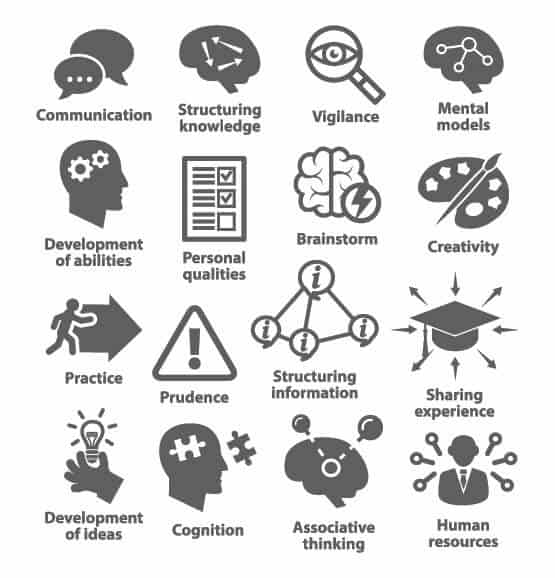
Knowledge management allows the organization to collect and maintain those lessons that have been learned by the team members for ease of retrieval and use for the future application. Knowledge management applies from the individual through the organization’s structure and is often associated therein. Knowledge management helps retain those things learned by dint of the organization’s actions and as such will capture what is often referred to as tribal knowledge. These tools can facilitate capturing what can often be painful lessons and are often commonly associated with learning opportunities.
Inter-Relationships

The term Inter-relationships is used instead of Systems Thinking as this includes the human aspects of any system. While Systems Thinking (Peter M. Senge, 1994) discusses the behavior of a system it leaves open the question of how the human aspect can and will affect the system. Therefore, using the term “Inter-relationships” opens the discussion to perspective variances, motivational factors, and other factors of the personal nature which impact the system or how the system is perceived by different people at different times.
Open Mental Models

While Senge discusses Mental Models in his book “The Fifth Discipline” and goes on to further discuss how one must be able to allow it to be changed as knowledge is gained; he does not bring this to the level that it should be discussed. To achieve this shared mental model requires the team be unafraid to clearly state their perspective. Hence, we have added the Open to it and discuss the different levels and effects that Mental Models have on all aspects of individuals, groups, and organizations, and the role this plays in continual development or improvement.
Learning Organization
- PMI Embracing Mistakes Learning from Experience
- PMI The Status Quo Problem
- PMI Project Management and the Learning Organization
- PDD – Project Development and the Learning Organization
- Fit Small Business Company Culture Ideas
- Peoplemaven Wise Hiring Managers with Can’t Miss Job Openings
- Fit Small Business Encourage Strong Work Ethic
- 22 Ways To Show A Strong Work Ethic To Your Employees In Experts View
- 8 cognitive biases that affect how you manage your team
- The Importance of Documenting Lessons Learned
- Project Management and the Learning Organization
- Two Sides (at Least to Every Story): Managing and Resolving Conflict
- More on Conflict Resolution
- Learning Management Systems or Training Systems By Experts
- 6 Mental Maladies That Could Impact Your Project
- Reward Proactive Action Over Firefighting
- How to Implement Organizational Development
- Technical Writer – Jon M Quigley
- Project Team and Cognitive Behavior
- Automation is Not a Silver Bullet
- Manufacturing, Automation and People
Learning Organization, Organization Development and Project Initiation
Learning Organization, Organization Development and Project Planning
Learning Organization, Organization Development and Project Execution
Beyond Buzzwords – Rethinking Collaboration in Software Development and Prioritization vs. Micromanagement – Finding the Right Balance – SPaMCAST 799 with Jon M. Quigley, MS PMP CTFL
Play Now: https://bit.ly/3PkHpyd
Show Notes and Web Player: https://bit.ly/3IKzgzy
Personal Process Improvement, Ethics in Software, People
Two Storytelling Techniques, Testing Conferences, Mental Models
Leadership Types, On-Boarding, Surprises in QA, Holy Trinity
SPaMCAST 575 – Messing Up Agile Hybrids, Deming and Book Club, Essays and Discussions
SPaMCAST 477 – Silence: A Powerful Tool, Muddling Through, Monolithic Monolith
SPaMCAST 479 – Mentor or Coach, TameFlow Chapter 21a, Employee Engagement
https://spamcast.libsyn.com/spamcast-479-mentor-or-coach-tameflow-chapter-21a-employee-engagement
SPaMCAST 483 – Measuring The Value of Agile, TameFlow Chapter 21, Agile Culture
SPaMCAST 552 – Fit For Value, Saying No, Essays and Discussions
https://spamcast.libsyn.com/spamcast-552-fit-for-value-saying-no-essays-and-discussions
SPaMCAST 703 – Commitment, Humans and Automation, Essays and Conversations
SPaMCAST 440 – Two Storytelling Techniques, Testing Conferences, Mental Models

Control Plan Gaps: What Most Quality Professionals Overlook
Control Plan Gaps: What Most Quality Professionals Overlook Control Plans are among the foundational quality tools within Advanced Product Quality Planning (APQP) and are required by IATF 16949. They help…
PPAP Risk Management: Why Most PPAP Approvals Still Fail at Production Launch
PPAP Risk Management: Why Most PPAP Approvals Still Fail at Production Launch I recently reviewed a visual guide titled “How to Create PPAP – Complete Practical Master Guide.“ Like many…
Project Management Review: Strengths, Weaknesses, and Critical Execution Gaps
Project Management Review of the Deeply Practical Project Management Framework The “Deeply Practical Project Management” framework offers a strong foundation for structured project execution. William Stewart sent me some of…
Executive Decisions and Product Launch Failure: When Success Becomes a Blind Spot
Executive Decisions and Product Launch Failure Most executives do not wake up in the morning intending to launch a defective product. They are not trying to damage customer trust. They…
Product Development Writing: Why Engineers Must Think Beyond Engineering
Product Development Writing — Engineering Beyond Engineering I never intended to become a writer. I intended to become a product development professional. Like many engineers, I initially believed technical competence…
Inspection Fallout: Why More Inspectors Do Not Fix Broken Processes
The reflex response after a defect escape is often predictable: add more inspectors. More containment. More gate reviews. More signoffs. More checklists. The organization feels pressure to “do something,” and…
Relaxation in Moderation: The Discipline Behind Sustainable Success
Relaxation in Moderation and Sustainable Success Relaxation is important. Recovery matters. Rest is necessary. But “relaxation in moderation” is an idea that deserves more scrutiny than most people give it.…
Product Launch Delays: Configuration Management Matters
Product Launch Delays Continue to Impact Automotive and Technology Programs A recent Gartner study noted that nearly half of product launches experience delays of at least one month. That statistic…
How to Use AI in Business Processes for Faster Quoting, Smarter Design, and Improved Manufacturing Quality
How to Use AI in Business Processes for Faster Quoting, Smarter Design, and Improved Manufacturing Quality Artificial intelligence is no longer experimental—it is becoming essential for companies looking to improve…
Why Most Testing Strategies Fail: The Real Problem Isn’t Testing
Why Most Testing Strategies Fail: The Real Problem Isn’t Testing This post is borne out of a LinkedIn post. If you’re responsible for testing, here’s a simple question: 👉 Do…
Pugh Matrix
[sdm_download id=”15559″ fancy=”0″]
How to Brainstorm
[sdm_download id=”15566″ fancy=”0″]
How to have better Meetings!
[sdm_download id=”15569″ fancy=”0″]
Expectations of Contractors & Engineers
[sdm_download id=”15570″ fancy=”0″]
Contact Value Transformation about LO-OD
Error: Contact form not found.