

APQP / PPAP
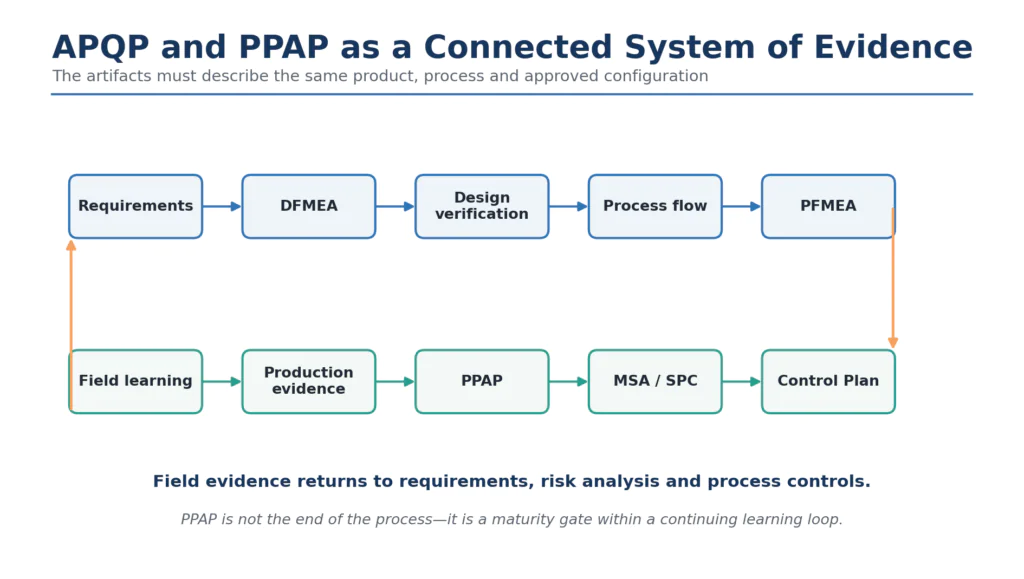
Advanced Product Quality Planning (from AIAG) (APQP / PPAP) provides the framework for the development and manufacturing of a product for a vehicle. The approach describes gathering customer input, developing the product; develop the process from which the product will be built at volume; validate the product and the processes; finally launch the product – production.

Voice of Customer/Requirements

The voice of the customer drives our product development endeavor. This is an understanding of the scope of the work and requirements are generated. The scope is refined to the level to which a strategy or approach to meet these customer demands can be identified and planned. This often entails the use of decision matrices (example: Pugh Matrix) and tools such as Quality Function Deployment (QFD).
Product Development

The product is iteratively and incrementally developed in the product development portion of the process. This consists of building models and prototypes of varying degrees of complexity and fidelity to the proposed final product. During each build, the product is explored, something is learned and alterations and refinements are made to the design. A tool known as the Design Failure Mode Effects Analysis (DFMEA) will help us to learn from the product as progress is made.
Process Development

In parallel with the development of the product comes the development of the processes that will ultimately produce the product at volume (Design for Manufacture and Assembly). This is often referred to as concurrent engineering. This shortens the product development cycle as well as limiting or greatly reducing rework. This work will entail setting up the manufacturing line, developing control plans, work instructions, poke yoke, DFMEA, process capability and much more.
Process/Product Validation
The validation of the product and the process helps ascertain the abilities of both the product and the manufacturing processes to meet the expectation or defined project and business goals. This phase includes trial production runs, run at rate runs, Measurement System Evaluation, Production Part Approval, and much more.
Launch

Quality management is the practices the organization employs to meet the customer quality expectation. There are techniques and tools used to deliver a cost effective quality product. This includes quality control, quality assurance, quality improvement, and quality planning. Product reliability is the quality of the product over time, and Total Quality Management is a comprehensive approach to continuous quality improvement.
APQP – Advance Product Quality Planning – an approach to automotive product development and manufacturing which includes tools and techniques in addition to processes for designing and manufacturing a quality product at automotive production volumes.
-
- The APQP approach to launching products, Part 1
- The APQP approach to launching products, part 2
- Automotive embedded development and testing
- The Art Career Project
- eHow UK Quality APQP & PPAP Definitions
- PD&D Project Management of Embedded Systems
- PD&D Collecting and Reporting Material Content
- EE Times; Standards Requirements and PPAP
- PMI Embedded Project Management – Automotive Style
- PD&D Printing of 3D Parts in Aerospace
- Pannam – Biggest Challenges faced by Developers
- 8 Logistics Skills That Can Help Advance Your Supply Chain Career
- Inline Bar code Verifier Systems: Validating Test Results
- Effective way to create a winning supply chain strategy – 6 River Systems
- DFMA lets engineers focus on what they do best – Assembly Mag
- Prototyping Complex Harnesses – Assembly Mag
- 13 Entrepreneurs Explain How Rescue A CEO
- Automotive Embedded Project Management and Product Development
- Gauge repeat ability and reproducibility
- DFMA lets engineering focus on what they do best
- 8D and A3 Formalize Problem Solving
- The APQP approach to launching products
- Parts, Quarantine and Recovery
- 3 Tips For Digitizing Your Shipping & Supply Chain
- All Your Eggs in One Basket
- Business Continuity Checklist for B2B Commerce
- TQM Tools: A Story of Product Discovery
- 5 Supply Chain Tips
- Quigley’s Corner: Failure Mode Effects Analysis
- Quigley’s Corner: On the Way to Delivery
- What is Exploratory Testing?
- 26 supply chain pros reveal the single most effective way to create a winning supply chain strategy
- Risk Management: A Principal Vendor Performance Management Benefit
- Top 6 Expert Opinions on Importance of Software Product Technical Audit
- Quigley’s Corner: Project Management for Automotive Engineers
- The challenges of testing increasingly complex systems
- SOFTWARE DEVELOPMENT FOR CARS IS A BIT DIFFERENT
- Battery powered vehicles are 100-year-old technology
- Best Practices in Strategic Vendor Management
- Be Careful of Dogma on Assembly Lines
- Just How “Green” are Battery-Powered Vehicle
- Supplier Risk Assessment
- How to Write a Clear, Successful Vendor Management Program
- Quigley’s C0rner: Motorcycle Sprint Racing
- Embedded Product Development Engineer
- Quigley’s Corner: While you were Working
- Asked Experts Why Carmakers Can’t Just Transition To Newer Chips In Stock.
- Quigley’s Corner: The Integrated Circuit Shortage – Blame the Customer?
- What are the advantages and disadvantages of modular design for electronics products?
- All Dev Teams Write Documentation. But Do Users Read It?
- INTERVIEW WITH SOFTWARE ENGINEERING SPECIALIST JON M. QUIGLEY
- Why The Chip Shortage Response is Complicated
- Hexagon Approach to New Product Development in EVs: Navigating Challenges and Innovations
Project Management for Automotive Engineers
Spamcast 380 – Kim Robertson, The Big Picture of Configuration Management
https://spamcast.libsyn.com/category/Configuration+Management
SPaMCAST 346 – Configuration Management, An Interview With Jon M Quigley
https://open.spotify.com/episode/0yNV2BTLZh5KNkUxf1hzZF
SPaMCAST 477 – Silence: A Powerful Tool, Muddling Through, Monolithic Monolith
Spamcast 380 – Kim Robertson, The Big Picture of Configuration Management
https://spamcast.libsyn.com/category/Configuration+Management
SPaMCAST 346 – Configuration Management, An Interview With Jon M Quigley
https://open.spotify.com/episode/0yNV2BTLZh5KNkUxf1hzZF
Peterman Design Firm- Conscious Management, An Interview With Jon M Quigley

Automotive Testing Expo 2026: Advancing Vehicle Testing and Verification
Automotive Testing Expo North America | October 27–29, 2026 | Novi, Michigan Modern vehicles are becoming increasingly complex. Software-defined vehicles, electrification, connected systems, and distributed electronics introduce new challenges for…
Automotive Project Management: Suppliers, Change & Risk
Automotive Project Management: Suppliers, Change & Risk By Steven G. Lauck Why Automotive Project Management Requires an Integrated Approach Automotive project management is about much more than maintaining a schedule,…

Project Risk Management: Six Steps to Deliver Expected Outcomes
Mitigating Risk No. 1: Deliver the Expected Outcome By Steven G. Lauck Even a well-planned project can miss its goal. This can waste time and money, damage trust, harm the…

Strategic Project Planning Under Uncertainty: Six Elements of a Credible Plan
Strategic Project Planning Under Uncertainty By Steven G. Lauck The Basics Most project plans create a sense of certainty from the outset, and that is part of the problem. Teams…
When Components Pass but Vehicles Fail | Automotive Quality
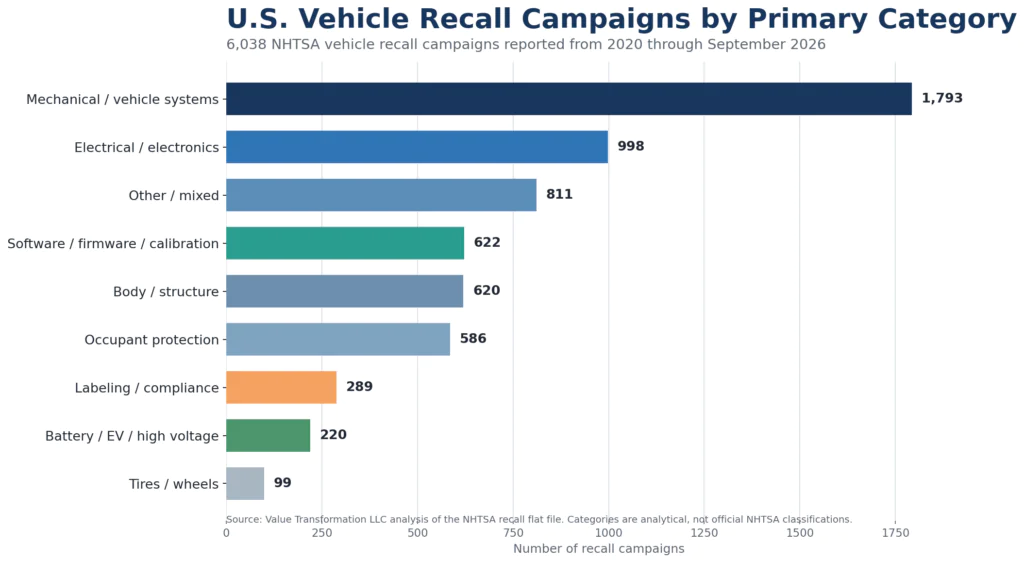
When Every Component Passes but the Vehicle Still Fails Distributed Features, Supplier Integration and the Growing Cost of Automotive Complexity I reviewed 6,038 NHTSA recall campaigns in preparation for a…
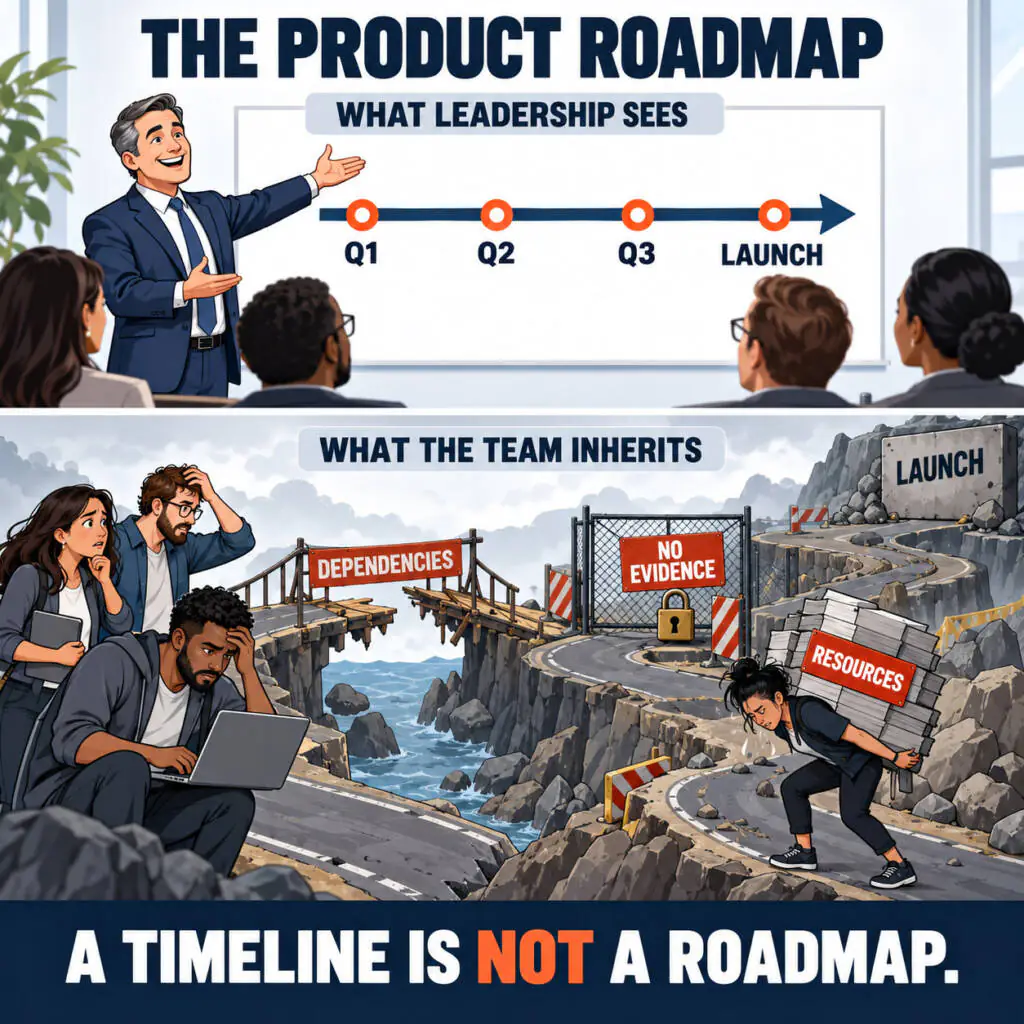
How to Build a Product Development Roadmap Teams Can Execute
How to Build a Product Development Roadmap Teams Can Execute A product development roadmap should help people make decisions. Too often, it becomes a presentation filled with attractive timelines, colored…
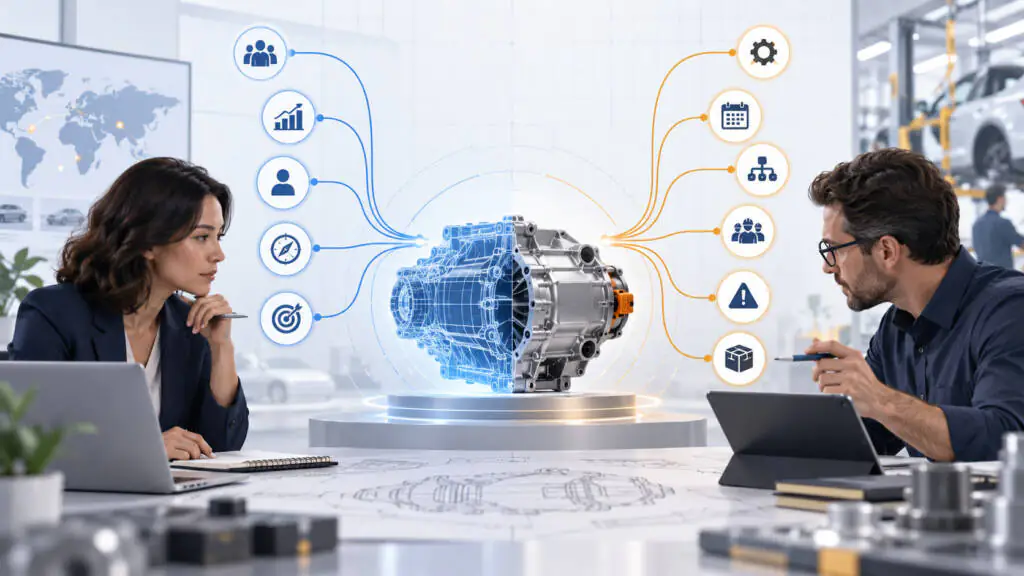
Product Management vs Project Management: Roles That Must Work Together
Product Management vs Project Management: Roles That Must Work Together Product management vs project management is often treated as a contest over ownership. It should not be. The two disciplines…
How Learning Organizations Turn Experience Into Capability
How Learning Organizations Turn Experience Into Capability Organizations do not learn simply because the people inside them gain experience. A learning organization turns what individuals discover—through decisions, experiments, failures, recoveries, and…
Business Doublespeak in Product Development
To Seem Rather Than to Be in Business and Product Development North Carolina I like North Carolina. I have spent many years here; it has a beautiful coast and nice…
Engineering Leadership During a Skills Shortage
Expanding Expert Capacity Without Lowering Standards The engineering skills gap is not simply a recruiting problem. It is a capacity, knowledge, and leadership problem. Organizations need experienced engineers who can…
Contact Value Transformation about APQP
Error: Contact form not found.