


Strategic Project Planning Under Uncertainty
 The Basics
Most project plans create a sense of certainty from the outset, and that is part of the problem. Teams set dates, estimate costs, assign resources, and establish milestones, often with little consideration for variation. Once start and finish dates appear on the schedule, the plan begins to feel concrete as though it can predict the future. In practice, however, project managers often manage closely to a plan they helped create, even when circumstances change. Years of experience have taught me that a strong plan depends on two essential principles:
- Treat the plan as a living document. It should evolve as new information emerges, assumptions are tested, and conditions change.
- Improve clarity at the outset. The more reliable and complete the initial information is, the stronger and more useful the project plan will be.
- Be explicit about uncertainty. Uncertainty does not prevent planning, but it does require honesty about what is known, what is assumed, and what still needs to be learned. Those distinctions may not be obvious at first, but identifying them early is essential. Articulation of the underlying assumptions that go into the plan is important.
Six elements of a credible project plan
A credible plan clearly distinguishes among facts, assumptions, decisions, experiments, commitments, dependencies, and contingencies. Each serves a distinct purpose; treating them as interchangeable can create false confidence.
1- Facts: The things we can refute or verify. The equipment has been selected. The site is available. The contract has been signed. These confirmed realities provide a reliable foundation for planning.
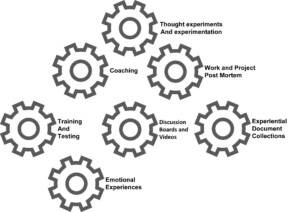
2- Assumptions: Beliefs we use for planning, even though they have not yet been fully validated. Team members may not even articulate these beliefs, but they are still there. (You want to see a demonstration of how to evoke assumptions; investigate planning poker.) We may believe the supplier can meet the schedule, the existing infrastructure has enough capacity, or the customer will approve of the proposed solution. Any of those beliefs may be reasonable, but each still carries risk. Assumptions are not inherently bad; every plan depends on them. The real danger is allowing important assumptions to remain hidden, untested, or mistaken for facts. Getting to these underlying assumptions requires exploration, which takes time and asking questions.
3- Decisions: These establish direction. We have chosen this technology. We will use this supplier. We will build rather than buy. A decision may be made with incomplete information, but it should still be explicit, documented, and understood by the people responsible for carrying it forward. Each decision depends on impacts and implications.
4- Experiments: These are purposeful, limited, and controlled efforts designed to answer an important question before the project makes a larger bet. An experiment deliberately reduces uncertainty before committing significant resources. It might take the form of a prototype, a supplier evaluation, a site investigation, a test run, or a focused technical study. The goal isn’t to prove the preferred solution is right; it is to gather enough evidence to make the next decision wisely.
This is where project planning becomes genuinely strategic: the plan does more than organize activity; it helps the team learn before uncertainty becomes expensive.
Instead of always asking, “How do we execute the plan?” we should also ask, “What do we still need to learn before we commit to it?” That question shifts attention from following a schedule to improving the quality of the decision behind it. That distinction can prevent costly rework, protect scarce resources, and, in some cases, save a project thousands of dollars.
5- Commitments are different again. They are the points at which the organization puts something meaningful at risk: money, contracts, people, time, reputation, or the ability to pursue another option. A commitment turns an intention into a consequence.
The objective is not to eliminate every uncertainty before committing. That is neither realistic nor necessary; projects most often move forward without perfect information. Where we know it is imperfect, we have risks.
The objective is to increase confidence to the point that commitment is reasonable, transparent, and proportionate to the remaining risk.
6- Finally, there are contingencies: the practical responses we prepare for when a key objective or the project does not unfold as expected.
What will we do if the supplier misses the date? If the technology does not perform as expected? If demand changes, a permit is delayed, or a critical assumption proves wrong? We will have metrics for supplier and technology performance, or permit-process measures, that will help us predict. Asking these questions early gives the team options when circumstances change.
A contingency is not an admission that the plan has failed or that the team lacks confidence. It shows someone looked beyond the preferred scenario and prepared the organization to respond, not react.
Taken together, facts, assumptions, decisions, experiments, commitments, and contingencies change the purpose of the project plan. These provide a basis for adapting.
The plan is no longer simply a document that tells everyone what happens next. It becomes a living mechanism for exposing uncertainty, guiding learning, sequencing commitments, and increasing confidence as the project moves forward.
That discipline matters most before irreversible spending makes changing direction difficult, disruptive, or prohibitively expensive.
Once a major contract is signed, equipment is ordered, construction begins, or key people are committed, the cost of reversing course can rise dramatically. By then, even a clearly better option may be too expensive or disruptive to pursue.
Strategic planning asks a different question before reaching that point:
 What can we do now to learn more before we spend more?
The answer will depend on the uncertainty we are trying to reduce. Sometimes we need another analysis or a closer look at the data. Sometimes the fastest path is a candid conversation with a supplier, customer, or technical expert. In other cases, a prototype, pilot, or field test can reveal more than weeks of discussion. Sometimes the most valuable step is simply challenging an assumption everyone has quietly accepted as true.
Good project leaders do not pretend uncertainty can be eliminated. They bring it into the open so the team can understand it, discuss it, and act on it. They separate what they know from what they assume. They make decisions explicitly, recognize when those decisions become real commitments, and run focused experiments to learn while the cost of changing direction remains manageable. They also prepare contingencies not because they expect failure, but because they understand that conditions can change.
The result is not a project plan that claims to predict the future with certainty. It is something far more useful: a project plan that helps the organization learn earlier, make better-informed commitments, and build confidence in the path ahead.
Call to action
Need help connecting supplier quality, configuration management, and system-level verification? Contact us; we will work with your team to transfer knowledge and capabilities.
Value Transformation LLC helps organizations improve product-development processes from concept and prototype through APQP, PPAP, production readiness, and field learning.

For more information, contact us:
The Value Transformation LLC store.
Follow us on social media at:
Amazon Author Central https://www.amazon.com/-/e/B002A56N5E
LinkedIn: https://www.linkedin.com/in/jonmquigley/
https://www.linkedin.com/company/value-transformation-llc
Follow us on Google Scholar: https://scholar.google.com/citations?user=dAApL1kAAAAJ
