

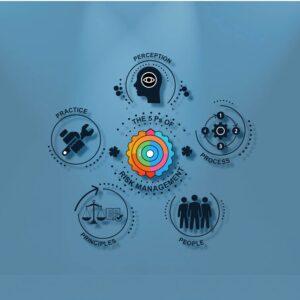
Risk Sensitivity Balance in Product Development and Manufacturing: Calculated Risks in a Technology-Driven World
In today’s hypercompetitive environment, product development and manufacturing risk management have become strategic differentiators. Organizations that master risk sensitivity balance outperform those that either recklessly gamble or cautiously stall innovation. I have spoken and taught on risk management. Whenever risk comes up, we have a short chat about the difference between developing an online video game that requires no credential login and developing a vehicle’s ABS. How we approach should be commensurate with the associated risk. The trick is to understand the possible risks and juxtapose these against the associated rewards.
The challenge is not whether to take risks — it is how to take calculated risks while maintaining operational stability and long-term profitability. This post is in response to Bob Rutherford’s post on LinkedIn.
Understanding Risk Sensitivity in Product Development
Risk sensitivity refers to how individuals, teams, and organizations perceive and respond to uncertainty. In product development and advanced manufacturing, this sensitivity shapes decisions involving:
-
New product launches
-
Emerging technologies
-
Capital investments
-
Supply chain strategy
-
Regulatory compliance
-
Quality management systems
Too little sensitivity leads to preventable failures. Too much sensitivity leads to stagnation.
Achieving a balance of risk sensitivity means distinguishing between intelligent caution and fear-based avoidance.
Calculated Risks: The Engine of Innovation
Innovation requires stepping into uncertainty. Every successful product — from electric vehicles to AI-enabled manufacturing systems — exists because someone accepted uncertainty. Great things do not happen without incurring some measure of risk. The confounding element is the uncertainty, too risk-averse, slows progress, too reckless, results in delivering a product that causes harm, and is not only a marketable product but a product that causes damage.
A calculated risk includes:
-
Defined assumptions
-
Structured risk assessment
-
Mitigation strategies
-
Contingency planning
-
Clear success metrics
Organizations that institutionalize calculated risk-taking create learning loops instead of blame cultures. In these environments, risk is managed — not avoided.
But this leads to a critical leadership question:
A
t what point does “mitigating risk” turn into institutionalized hesitation?
When mitigation processes become excessive gatekeeping, endless reviews, or bureaucratic paralysis, risk management ceases to protect value — it begins to destroy opportunity.
Institutionalized Hesitation in Manufacturing Organizations
Institutionalized hesitation occurs when:
-
Decision cycles stretch indefinitely
-
Innovation pipelines stall
-
Approval layers multiply
-
Leaders avoid accountability
-
Fear of failure overrides strategic intent
- Our processes and procedures prohibit exploration beyond what is known
In highly regulated industries like automotive, aerospace, and medical device manufacturing, strong risk governance is essential. However, without a risk sensitivity balance, governance morphs into resistance.
The cost?
-
Missed market windows
-
Competitive disadvantage
-
Talent disengagement
-
Obsolescence
True leadership demands the courage to differentiate between real risk exposure and discomfort with uncertainty.
Technology and Risk in Product Development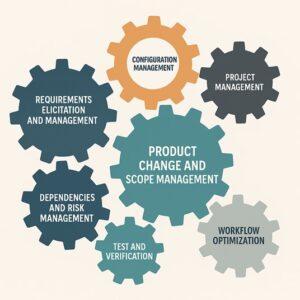
Technology dramatically reshapes both the magnitude and nature of risk.
Positive Impacts of Technology on Risk Management
1. Predictive Analytics & AI
Advanced data models identify failure patterns before they occur, reducing quality escapes and warranty claims.
2. Digital Twins
Simulations allow engineers to test scenarios virtually, minimizing the need for costly physical prototypes.
3. Automation & Robotics
Reduced human error improves manufacturing consistency and safety.
4. Real-Time Supply Chain Monitoring
IoT-enabled systems enhance visibility and mitigate disruption risks.
These tools enhance risk sensitivity balance by transforming unknown risks into measurable probabilities.
Negative Impacts of Technology on Risk
Technology also introduces new layers of vulnerability:
1. Cybersecurity Risks
Connected manufacturing systems are attractive targets for attackers.
2. Overreliance on Data Models
Algorithms can create false confidence when assumptions are flawed.
3. Technology Complexity Risk
Increased system interdependencies amplify cascading failures.
4. Skill Gaps
Advanced systems require competencies that may not exist internally.
In short, technology reduces some risks while amplifying others. Without disciplined governance, digital transformation can accelerate failure as quickly as it accelerates productivity.
Balancing Innovation and Operational Stability
Organizations must ask:
-
Are we avoiding risk, or managing it?
-
Are we data-informed or data-paralyzed?
-
Are we empowering engineers or over-controlling them?
Maintaining risk sensitivity balance requires:
1. Clear Risk Principles
Define what risks are acceptable and why.
2. Structured but Agile Processes
Stage-gate systems should enable learning, not stall it.
3. Leadership Alignment
Executive teams must model intelligent risk-taking.
4. Transparent Communication
Make risk visible and discussable across functions.
Risk Sensitivity Balance as a Competitive Advantage
Companies that consistently win in product development understand a powerful truth:
Risk avoidance does not create safety.
Risk intelligence creates advantage.
When organizations master risk sensitivity balance, they:
-
Shorten innovation cycles
-
Improve manufacturing resilience
-
Increase product quality
-
Enhance customer trust
-
Accelerate time-to-market
The goal is not eliminating uncertainty — that is impossible. The goal is building systems and cultures capable of navigating uncertainty deliberately.
From Risk Mitigation to Risk Mastery
Risk is neither enemy nor ally. It is a constant.
The real danger lies not in taking calculated risks — but in mistaking hesitation for prudence. When mitigation becomes an excuse for inaction, growth halts.
Revisit the question:
At what point does “mitigating risk” turn into institutionalized hesitation?
The answer lies in whether your systems enable informed movement or prevent motion entirely.
In modern product development and manufacturing, sustainable success depends on achieving and maintaining a balance of risk sensitivity — the disciplined equilibrium between caution and courage.

For more information, contact us:
The Value Transformation LLC store.
Follow us on social media at:
Amazon Author Central https://www.amazon.com/-/e/B002A56N5E
Follow us on LinkedIn: https://www.linkedin.com/in/jonmquigley/
https://www.linkedin.com/company/value-transformation-llc
Follow us on Google Scholar: https://scholar.google.com/citations?user=dAApL1kAAAAJ
