
When Margins Are Unknown: Why Manufacturing Controls Fail Without Clear Design Intent
 When the Margin Is Unknown, Control Becomes Reaction
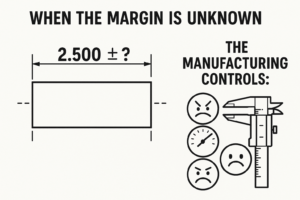
Not everything can be turned into a process. This is especially true in early product development, where learning, discovery, and iteration dominate. However, when ambiguity persists beyond its appropriate stage—especially around dimensions, tolerances, and margins—organizations unintentionally transfer risk downstream. The image illustrates a simple truth: when the margin is unknown, manufacturing controls are forced to react emotionally rather than systematically. This is where unknown tolerance risk begins to erode both product development effectiveness and manufacturing stability.
Unknown Tolerance Risk in Product Development
In product development, tolerances represent assumptions about performance, fit, function, and manufacturability. When those assumptions are vague, deferred, or undocumented, development teams move forward without understanding how much variation the design can tolerate.
The Hidden Cost of “± ?” in Design

What is really heppening?
An undefined tolerance—symbolized by “2.500 ± ?”—is not flexibility; it is uncertainty. How do we know we are building the thing correctly? What tools and gauges will be needed? That uncertainty creates unknown tolerance risk by:
-
Masking design weaknesses
-
Preventing meaningful manufacturing studies
-
Delaying critical manufacturability feedback
-
Encouraging optimistic assumptions
When product development fails to intentionally define margins, manufacturing inherits the problem without the context needed to solve it. What is allowable in terms of variation will be part of the equation for setting up the manufacturing line.
Manufacturing Controls Are Not Designed to Solve Design Ambiguity
Manufacturing controls—gauges, inspections, SPC, and procedures—exist to manage known variation. They are not designed to compensate for undefined design intent. If you do not have tolerances for design and manufacturing, how can you establish control charts, and how effective will they be? This was a conundrum we encountered in some of our consulting engagements. Even before that, what sort of controls need to be in place (born from the PFMEA and control plan).
Why Manufacturing “Gets Angry”
The image’s frustrated faces reflect an everyday reality. When tolerances are unclear:
-
Inspection plans become arbitrary
-
Scrap and rework increase
-
Operators make judgment calls they were never meant to make
-
Control systems oscillate instead of stabilizing
This is an unknown tolerance risk manifesting as operational noise. Manufacturing is blamed for the variability that was built into the upstream.
The Transfer of Risk from Development to Manufacturing
One of the most consistent failure patterns across industries is risk transfer disguised as progress. When product development defers decisions on margins, tolerances, or constraints, it does not eliminate risk—it relocates it.
Symptoms of Risk Transfer

APQP example
-
Late-stage tolerance “tightening”
-
Emergency process changes
-
Over-inspection as a substitute for clarity
-
Increased dependence on tribal knowledge
In these cases, unknown tolerance risk becomes systemic, affecting cost, schedule, quality, and morale.
Managing Unknown Tolerance Risk Across the Lifecycle
Effective organizations treat tolerance definition as a risk management activity, not a drafting exercise.
In Product Development
- Define tolerances as hypotheses, then validate them
-
Explicitly document what is unknown and why
-
Use early manufacturing engagement to surface sensitivity
-
Update tolerances as learning occurs—not after release
In Manufacturing
-
Escalate unclear tolerances as design risks, not shop-floor problems
-
Track deviations linked to ambiguous requirements
-
Avoid compensating for uncertainty with informal adjustments
The goal is not perfection—it is intentional clarity.
Controls Can’t Fix What Was Never Defined
The image captures a fundamental lesson: manufacturing controls react poorly when asked to manage the unknown. When margins are unclear, frustration replaces stability, and effort replaces insight. Reducing unknown tolerance risk requires discipline in product development and honesty about what manufacturing systems can—and cannot—control.
Define the margin, and the system can work. Ignore it, and the system will push back and we will not know what or how to correct.

For more information, contact us:
The Value Transformation LLC store.
Follow us on social media at:
Amazon Author Central https://www.amazon.com/-/e/B002A56N5E
Follow us on LinkedIn: https://www.linkedin.com/in/jonmquigley/
https://www.linkedin.com/company/value-transformation-llc
Follow us on Google Scholar: https://scholar.google.com/citations?user=dAApL1kAAAAJ
