Brainstorming can be used for problem-solving as well as uncovering alternative approaches that may improve the cost structure for the product or process. Brainstorming is conducted multidiscipline to gather the most perspectives possible from which selection of the best possible solution will be made. We will employ many team idea generating and collecting methods as well as the use of tools such as mind mapping to build associations from which we can generate the best solution. Brainstorming does not apply solely to cost, but can also be applied to design solutions as well. We have used this technique many times to improve cost and generate intellectual property (patents).
FAST is an acronym for functional analysis system technique. FAST allows us to reduce ambiguity in the definition of a functional product or a functional process. Value of a product is interpreted differently by different customers. Characteristics that are common to value are high level performance, capability, emotional appeal, and style relative to its cost. Value is generally expressed in terms of maximizing the function.
Value = (Performance + Capability)/Cost
Value = Function/Cost
Lean is a set of techniques that are typically employed to improve the costs in manufacturing by reducing waste, but not exclusively. In fact, this technique can be applied to process management in general, such as product development, and not just manufacturing. Cost improvement comes from managing and controlling aspects of manufacturing that have increase the cost. This includes transportation, inventory, motion, wait, over processing, over production, and defects.
Make or buy analysis considers the scope and objective of the work compared to the company strategies and tactics for growth. Make refers to the company decision to internally handle the design and or fabrication of the component or subassembly. Buy refers to outsourcing the component or subassembly. There can be many compelling reasons to select one or the other of these alternatives rather than leave to random chance or little forethought.
Teardowns are used to learn the cost implications of the design, often another manufacturer of the product. Tearing the product down is one method to identify and understand the cost drivers for the product. This includes the manufacturing, material composition and assembly of the product. The teardown will be multidiscipline approach to obtain a multitude of perspectives that will help ascertain the constituents of the product cost. This can be material, design or methods of production. that is generated relative to a product regardless of source as well as data mining of that information
Configuration and Data Management processes were first documented in the United States by the U. S. Department of Defense. Out of these requirements grew much of what is found in ISO and GEIA standards. While the currently defined requirements matured over the last 70 years their history pre-dates the Phoenicians and China’s first dynasty.
The commercial world is governed by market change dynamics that greatly influence CM considerations, but also the viability and sustainability of products and the infrastructure required to market and support them. This is a much broader application than strictly government considerations for systems and goods often driven by logistical necessity or by a response to international considerations.
The validation of the product and the process helps ascertain the abilities of both the product and the manufacturing processes to meet the expectation or defined project and business goals. This phase includes trial production runs, run at rate runs, Measurement System Evaluation, Production Part Approval, and much more.
Configuration identification is the process for discovering and categorizing the attributes associated with the hardware or the software. These are recorded and will comprise the baseline of the product.
The first U.S. Verification Model (V-Model) appeared in a proposal from Hughes Aircraft in 1982 for the U.S. Federal Aviation Administration’s advanced automation system program. From the V-Model came our current conceptions of allocation, validation, and verification. Allocation assigns product requirements to systems and subsystems. Validation assures that the configuration was built to the engineering aka did we build it right. Verification assures all allocated requirements of a configuration have been met aka did we build the right thing.
CM could not exist without its sub-element data management (DM). Although CM is most often associated with a product, DM is associated with every record in the company regardless of form or format. Data Management can be traced to the Samarian culture.
Status and accounting is the activity involved in the collection, management, accounting for, and reporting on all of the information that is generated relative to a product regardless of source as well as data mining of that information
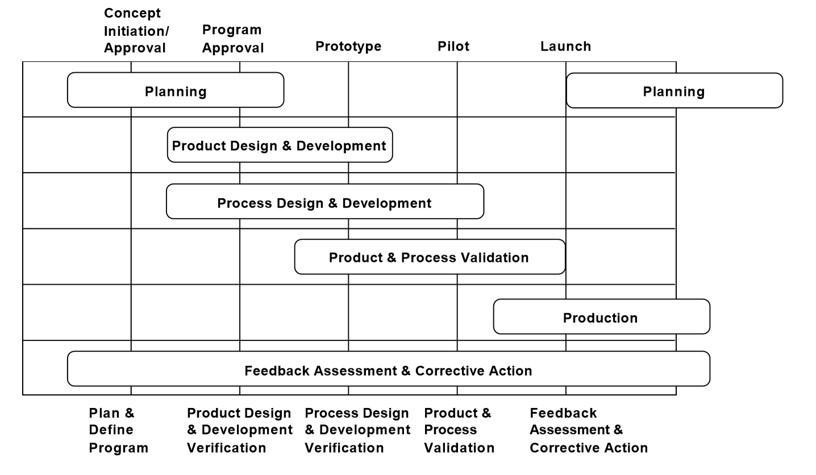
The voice of the customer drives our product development endeavor. This is an understanding of the scope of the work and requirements are generated. The scope is refined to the level to which a strategy or approach to meet these customer demands can be identified and planned. This often entails the use of decision matrices (example: Pugh Matrix) and tools such as Quality Function Deployment (QFD).
The product is iteratively and incrementally developed in the product development portion of the process. This consists of building models and prototypes of varying degrees of complexity and fidelity to the proposed final product. During each build, the product is explored, something is learned and alterations and refinements are made to the design. A tool known as the Design Failure Mode Effects Analysis (DFMEA) will help us to learn from the product as progress is made.
In parallel with the development of the product comes the development of the processes that will ultimately produce the product at volume (Design for Manufacture and Assembly). This is often referred to as concurrent engineering. This shortens the product development cycle as well as limiting or greatly reducing rework. This work will entail setting up the manufacturing line, developing control plans, work instructions, poke yoke, DFMEA, process capability and much more.
The validation of the product and the process helps ascertain the abilities of both the product and the manufacturing processes to meet the expectation or defined project and business goals. This phase includes trial production runs, run at rate runs, Measurement System Evaluation, Production Part Approval, and much more.
Quality management is the practices the organization employs to meet the customer quality expectation. There are techniques and tools used to deliver a cost effective quality product. This includes quality control, quality assurance, quality improvement, and quality planning. Product reliability is the quality of the product over time, and Total Quality Management is a comprehensive approach to continuous quality improvement.
There are times when the best solution for the project strategy is agile. Agile strips away many of the processes relying instead upon the ability and talent of the team to discover, overcome or circumvent the obstacles presented. Predominantly used for software, though not exclusively, agile can be a quick way to respond to the unknowns in the product development effort. This area contains, product backlog, sprint backlog, estimating techniques, burn down charts, and retrospective. This area also contains a significant level of learning organization discipline.
Lean consists of a set of principles and techniques often associated with efficient and cost effective manufacturing. These tools and techniques are designed to eliminate waste in whatever form it may take, from scrap or reworked material to idle time and material flow and inventory. The approach is that of continuous and incremental improvement.
Value Transformation LLC offers a variety of training approaches to developing your team. In all instances, concrete objectives are identified. For non-custom training, those objectives are identified in the course catalog along with duration and prerequisites. We use well-defined rubrics, formative assessments to gauge the present level of skill, and summative assessments to ascertain the final degree of ability.
We have a process driven approach to learning. We couple the theoretical with the actual world and do not just work from the lectern but have games and exercises that help drive the learning. Where possible we demonstrate, then guided practice, they are there when the student works through the using the skill or technique solo or in teams.
Check out our course catalog or visit the download section of the website.
Value Transformation provides coaching for your managers and key technical staff in specific product management or project management areas (see our specialty topics) or in the context of the organization and the work being done. This includes Scrum team development or on specific projects to grow the talent and improve the outcomes along the way. It need not be project based but can be functional based, for example, development of the product testing and verification group.
Coaching is designed to facilitate the growth in capabilities in one person, a specific team, or a specific department and can be a short or long-term endeavor and is flexible in scheduling. The time can be fixed per week, or per month or as needed. We can coach from on site, our preferred way, or a combination of on-site and virtual methods.
Coaching can also take the form of assistance with developing your agile or scrum teams. The Value Transformation staff have experience using scrum for embedded software projects as well as adaptations to the line management with great increases in efficacy. A short, non-exhaustive list of the areas upon which we can coach is found below.
Value Transformation provides coaching for your managers and key technical staff in specific product management or project management areas (see our specialty topics) or in the context of the organization and the work being done. This includes Scrum team development or on specific projects to grow the talent and improve the outcomes along the way. It need not be project based but can be functional based, for example, development of the product testing and verification group.
Coaching is designed to facilitate the growth in capabilities in one person, a specific team, or a specific department and can be a short or long-term endeavor and is flexible in scheduling. The time can be fixed per week, or per month or as needed. We can coach from on site, our preferred way, or a combination of on-site and virtual methods.
Coaching can also take the form of assistance with developing your agile or scrum teams. The Value Transformation staff have experience using scrum for embedded software projects as well as adaptations to the line management with great increases in efficacy. A short, non-exhaustive list of the areas upon which we can coach is found below.
Value Transformation LLC is available for speaking events on many business, team building, project and product management topics. From technical to organizational development and motivational speaking, we have the talent with a demonstrated track record available for your event.
The fact that the Value Transformation Team members have decades and a variety of experience places them in the position to see how a collection of subsystems (product management, project management, and business) interact to produce the desired results along with some unintended consequences. This ability to see the forest and the trees and make analogies of technical concepts to easily understood events ensures that people will walk away having learned something while being entertained. In general, the topic areas upon which we consult and teach are also fodder for speaking events, though not exclusively so.
Value Transformation LLC is available for speaking events on many business, team building, project and product management topics. From technical to organizational development and motivational speaking, we have the talent with a demonstrated track record available for your event.
The fact that the Value Transformation Team members have decades and a variety of experience places them in the position to see how a collection of subsystems (product management, project management, and business) interact to produce the desired results along with some unintended consequences. This ability to see the forest and the trees and make analogies of technical concepts to easily understood events ensures that people will walk away having learned something while being entertained. In general, the topic areas upon which we consult and teach are also fodder for speaking events, though not exclusively so.
With mentoring a Value Transformation member will support a specific member of your team to develop the competencies and capabilities of that team member. This is a one on one connection between one of our team members and your talent. The selection of our personnel will be based on technical capacity and availability, or on request.
The focus of the mentoring can cover a range of topics. The duration may be fixed, and the topics can be varied, unlike coaching which is singular focus. The topic areas upon which we mentor range from project management to product management and line management. Typically, this mentoring will be one topic, but not exclusively, or on just one part of the topic, for example, Configuration Identification activities.
With mentoring a Value Transformation member will support a specific member of your team to develop the competencies and capabilities of that team member. This is a one on one connection between one of our team members and your talent. The selection of our personnel will be based on technical capacity and availability, or on request.
The focus of the mentoring can cover a range of topics. The duration may be fixed, and the topics can be varied, unlike coaching which is singular focus. The topic areas upon which we mentor range from project management to product management and line management. Typically, this mentoring will be one topic, but not exclusively, or on just one part of the topic, for example, Configuration Identification activities.
Value Transformation consults on the topics that we provide training (product development, manufacturing, product management and project management topics) and much more. Consultations can be direct or on your site, or remotely via telephone, Skype or other media. In either approach, our staff will work as a team member providing years of hard acquired experience into your team building capability along the way.
Consulting will often consist of onsite work collaborating with your team along with offsite work to develop strategies or to perform analysis of data acquired from your team and organization. Consulting duration can be fixed, based upon achieving a specific metric driven objective, or the contents of a statement of work.
Value Transformation consults on the topics that we provide training (product development, manufacturing, product management and project management topics) and much more. Consultations can be direct or on your site, or remotely via telephone, Skype or other media. In either approach, our staff will work as a team member providing years of hard acquired experience into your team building capability along the way.
Consulting will often consist of onsite work collaborating with your team along with offsite work to develop strategies or to perform analysis of data acquired from your team and organization. Consulting duration can be fixed, based upon achieving a specific metric driven objective, or the contents of a statement of work.
Quick problem solving is like consulting work, however, may require a more active role by Value Transformation staff. These are less scheduled and more subject to needs as a circumstance presents itself. It can be specific process failures or product failures from which containment, root cause, and quick recovery are necessary. Value transformation will augment your existing team to determine the root cause of the situation and propose corrective actions as well as mitigating actions, acting like a tiger team to resolve the problem.
For example, perhaps you have quality issues you would like to explore. We can use our Total Quality Management expertise to help identify the possible sources of the malady, then we can lead specific A3 or 8D root cause analysis work to determine the root cause. We can then work with your team or solo to proffer specific solutions. This service does not process specific but applies also to product failures which may be due to environmental contaminants or stimulus. Our team members can help explore and understand the nature of the failure to determine the corrective action that could take place to eliminate or remediate.
The exploration may require some physical testing to test the hypothesis, we can help by specifying those tests and, in some instances, conduct. This exploration is not limited to the product but also to the manufacturing line where tools like Total Quality Management techniques can be used to assist in discovering specific improvement areas.
Value Transformation LLC offers a variety of training approaches to developing your team. In all instances, concrete objectives are identified. For non-custom training, those objectives are identified in the course catalog along with duration and prerequisites. We use well-defined rubrics, formative assessments to gauge the present level of skill, and summative assessments to ascertain the final degree of ability.
We have a process driven approach to learning. We couple the theoretical with the actual world and do not just work from the lectern but have games and exercises that help drive the learning. Where possible we demonstrate, then guided practice, they are there when the student works through the using the skill or technique solo or in teams.
Check out our course catalog or visit the download section of the website.
Value Transformation LLC offers a variety of training approaches to developing your team. In all instances, concrete objectives are identified. For non-custom training, those objectives are identified in the course catalog along with duration and prerequisites. We use well-defined rubrics, formative assessments to gauge the present level of skill, and summative assessments to ascertain the final degree of ability.
We have a process driven approach to learning. We couple the theoretical with the actual world and do not just work from the lectern but have games and exercises that help drive the learning. Where possible we demonstrate, then guided practice, they are there when the student works through the using the skill or technique solo or in teams.
Check out our course catalog or visit the download section of the website.