


What Automotive and Embedded Systems Teach Us About Complex Projects
 Automotive and embedded product development provides a demanding classroom for complex project management. A modern vehicle or industrial system brings together electronics, software, mechanical components, networks, suppliers, manufacturing processes, test systems, regulatory obligations, and customer expectations. Each element may perform correctly on its own, yet the complete system can still fail.
That is one of the central lessons from embedded systems projects: complexity does not live only inside the components. It also lives in the connections, timing relationships, assumptions, decisions, and changes that cross organizational and technical boundaries.
The same lesson applies beyond automotive. Aerospace, medical devices, industrial equipment, energy systems, and connected products all depend on coordinated work across disciplines. The labels may change, but the project-management problem remains: a seemingly local decision can create consequences across the entire system.
Complex Projects Fail at the Intersections
 Project teams often organize work by discipline. Hardware engineers focus on electronics. Software teams develop code. Mechanical teams manage packaging and structures. Manufacturing engineers design the production process. Suppliers concentrate on their contracted components. Project managers track milestones, budgets, and deliverables.
This division of work is necessary, but it creates a risk. The product does not experience those organizational boundaries. It experiences the system.
A component can meet its specification and still create a system failure. A controller may function correctly on a bench but fail in the vehicle because of network loading, voltage transients, thermal conditions, connector behavior, startup sequencing, or an incorrect software configuration. A mechanical change may solve a packaging problem while placing new stress on a wire harness. A change in message frequency may improve one function while increasing network traffic or processor loading elsewhere.
The most difficult failures often occur at interfaces:
- Hardware-to-software interfaces
- Electrical-to-mechanical interfaces
- Component-to-vehicle interfaces
- Product-to-manufacturing interfaces
- Supplier-to-customer interfaces
- Requirement-to-test interfaces
- Technical-to-organizational interfaces
Complex project management must therefore do more than track the completion of individual work packages. It must manage the relationships among them.
Interfaces Are Project Deliverables
An interface is often treated as a line between two boxes on an architecture diagram. In practice, it is a collection of agreements. Those agreements may include signal definitions, connector pins, voltage ranges, physical dimensions, data formats, timing requirements, fault responses, ownership, revision levels, and acceptance criteria.
If those agreements are vague, assumed, or scattered across several documents, the project is carrying hidden risk.
I have seen teams spend substantial time diagnosing what first appeared to be a component defect, only to discover that two groups had interpreted the same interface differently. Both groups believed they were correct. In isolation, they may have been. At the system level, the interface was still broken.
For embedded systems projects, manage interface definitions as real deliverables. They need owners, baselines, reviews, change control, and verification evidence. An interface control document, network database, pinout, drawing, or API definition is not administrative paperwork. It is part of the product.
Program managers should ask:
- Who owns each interface?
- Which document defines the agreement?
- What revision is authoritative?
- How will the interface be verified?
- What other components or teams are affected if it changes?
These questions expose uncertainty before it becomes rework.
Timing Dependencies Create Hidden Complexity
Embedded products operate in time. A function must not only produce the correct result; it must produce that result within the required window and in the correct sequence.
Consider a controller during vehicle startup. Power must stabilize. The processor must initialize. Software must load. Network communication must begin. Sensors and other controllers must become available. Diagnostic checks may need to complete before the function is enabled. Each activity can work correctly on its own, but the complete function may fail if one element takes too long or occurs out of order.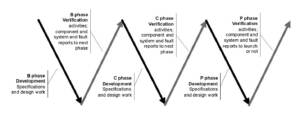
Timing also affects project execution. Software may be ready, but representative hardware is not available. Hardware may be available, but the wire harness is built to an earlier revision. A test bench may be complete, but the calibration data or network definition has changed. A supplier may deliver on the contracted date, yet deliver too late to support system integration before a major program gate.
This is why milestone completion does not necessarily equal system readiness. A collection of completed tasks is not the same as an integrated, verified product.
The project schedule must show technical dependencies, integration points, test-asset availability, configuration needs, and evidence maturity—not merely department-level finish dates.
Hardware and Software Develop at Different Speeds
Hardware and software do not mature in the same way. Hardware changes may require drawings, tooling, purchased material, prototype builds, laboratory work, and manufacturing changes. Software can often change more quickly, but frequent software releases introduce their own configuration and regression risks.
This difference can create a dangerous assumption: that software can compensate for any late hardware problem. Sometimes it can. Sometimes the workaround adds processing load, masks a physical weakness, creates a new diagnostic condition, or increases long-term maintenance complexity.
The reverse assumption is equally risky. A hardware change that appears small may alter software behavior, calibration limits, diagnostic thresholds, test procedures, service information, or regulatory evidence.
The practical lesson is not that one discipline should control the other. Hardware and software decisions require joint evaluation. Architecture reviews, change reviews, design reviews, and test planning should include the disciplines affected by the decision—not only the group initiating it.
Local Changes Can Produce System-Wide Consequences
Complex systems are full of change. Requirements evolve. Suppliers identify constraints. Tests reveal new information. Manufacturing exposes assembly problems. Customers refine expectations. Change is not evidence that the project is poorly managed; unmanaged change is.
In automotive and embedded development, a change to a single component can affect:
- Requirements and system architecture
- Drawings, bills of material, and software baselines
- Network communication and diagnostics
- DFMEA, PFMEA, and Control Plans
- Verification procedures and regression testing
- Manufacturing tooling and work instructions
- Supplier commitments and inventory
- Service procedures and field support
- Compliance or customer-submission evidence
A change request should therefore answer more than, “Can this component be changed?” It should ask, “What does this change touch, what evidence must be repeated, and who must know?”
This is where configuration management becomes essential. Teams need to know which hardware, software, calibration, drawing, requirement set, and test procedure produced a given result. Without that baseline, a passing test may tell us very little about the product we intend to release.
Regulatory and Quality Constraints Must Shape the Work
Regulatory, safety, quality, and customer requirements cannot be added at the end of the project as a final inspection. They influence architecture, development methods, documentation, traceability, risk analysis, supplier controls, testing, and release decisions from the beginning.
The important word is evidence.
A team may believe a product is safe, reliable, and compliant. The project must still produce objective evidence showing how requirements were identified, risks were addressed, designs were reviewed, changes were controlled, and performance was verified under appropriate conditions.
This does not mean creating documents for their own sake. The best evidence comes from the work itself. Requirements connect to design decisions. Design risks connect to engineering tests. Process risks connect to Control Plans and process validation. Test results connect to known configurations. Deviations and failures connect to decisions and corrective actions.
When these connections are weak, teams often create a large documentation effort near the end of the program. That effort is expensive, rushed, and vulnerable to gaps. When evidence is built as the project progresses, quality becomes part of execution rather than a gate before release.
Verification Is a Learning System
 Testing is sometimes treated as the activity that confirms the design after development is complete. That view is too narrow. Testing should also reduce uncertainty while the team still has time to act on what it learns.
Effective embedded systems projects use layers of verification:
- Analysis, modeling, and simulation to challenge early assumptions
- Component testing to understand local behavior
- Software-in-the-loop and hardware-in-the-loop testing where appropriate
- Subsystem testing to examine interfaces and interactions
- System testing in representative operating conditions
- Manufacturing and process validation to confirm repeatable production
- Field learning to compare expected and actual use

Each level answers different questions. Passing a component test does not prove system performance. Passing a system test once does not prove the manufacturing process can reproduce the result. Verification must match the risk and the decision the team needs to make.
Short design-build-test-learn cycles are particularly valuable. They expose incorrect assumptions earlier, when alternatives remain available, and the cost of change is lower. The objective is not to conduct the greatest number of tests. It is to obtain useful evidence early enough to influence the product and project.
Suppliers Are Part of the System
 Automotive programs depend on suppliers for components, software, tooling, test services, and production processes. A purchase order defines a commercial relationship, but it does not automatically create technical alignment.
Suppliers need the right requirements, interface definitions, timing expectations, configuration information, validation responsibilities, and change-notification rules. The customer must also understand supplier constraints and lead times. When information arrives late or changes without an impact assessment, the supplier’s problem quickly becomes the program’s problem.
Supplier management should therefore include more than delivery tracking. It should examine technical maturity, open assumptions, quality evidence, change status, test readiness, production readiness, and recovery plans. The goal is not to manage the supplier from a distance. It is to make supplier work visible within the full system plan.
Practical Lessons for Managing Complex Projects
The following practices translate well from automotive development to other complex programs.
1. Define the System Before Managing the Pieces
Clarify the product boundary, major functions, stakeholders, operating environment, dependencies, and measures of success. If the system is poorly defined, the project plan will optimize fragments.
2. Give Interfaces Owners and Evidence
Document critical interfaces, assign ownership, establish baselines, and define how each interface will be tested. Do not leave interface management to informal conversations.
3. Integrate Earlier Than Feels Comfortable
Early integration will reveal problems. That is its value. Use prototypes, simulations, representative test assets, and staged builds to discover interaction problems before the final system comes together.
4. Connect Requirements, Risks, and Tests
Requirements should drive architecture and verification. DFMEA and other risk analyses should influence engineering tests. PFMEA should influence the Control Plan and process-validation work. These are connected parts of one learning and assurance system.
5. Manage Configurations, Not Just Documents
A file revision alone is not a product baseline. Control the relationship among hardware, software, calibration, drawings, bills of material, requirements, and test procedures.
6. Evaluate Change at the System Level
Require cross-functional impact analysis for technical changes. Consider product performance, manufacturing, suppliers, test evidence, service, cost, schedule, and compliance before approval.
7. Measure Readiness With Evidence
Percent complete can create false confidence. Use measures tied to demonstrated maturity: requirements verified, interfaces proven, risks retired, defects closed, configurations controlled, production processes validated, and evidence accepted.
8. Preserve Transparency
Bad news does not improve with age. Teams must make uncertainty, failed tests, conflicting assumptions, and emerging risks visible without turning every problem into a search for blame. Transparency gives leaders time to make better decisions.
Complex Project Management Requires Systems Thinking
Automotive and embedded development teaches us that the project and the product cannot be managed separately. The schedule reflects the architecture. The risk register reflects technical uncertainty. Supplier timing affects integration. Configuration control affects the meaning of test results. Manufacturing capability affects whether a validated design can become a reliable product.
The program manager does not need to replace the systems engineer, software engineer, quality engineer, or manufacturing engineer. The program manager does need to understand how their work connects—and create the cadence, visibility, decisions, and evidence needed to keep those connections intact.
That is the broader lesson of embedded systems projects. Success does not come from optimizing every component independently. It comes from managing the interactions, learning quickly, controlling change, and protecting the integrity of the complete system from concept through production and use.


For more information, contact us:
The Value Transformation LLC store.
Follow us on social media at:
Amazon Author Central https://www.amazon.com/-/e/B002A56N5E}
Follow us on LinkedIn: https://www.linkedin.com/in/jonmquigley/
https://www.linkedin.com/company/value-transformation-llc
Follow us on Google Scholar: https://scholar.google.com/citations?user=dAApL1kAAAAJ
