


Project Management Review of the Deeply Practical Project Management Framework
The “Deeply Practical Project Management” framework offers a strong foundation for structured project execution. William Stewart sent me some of his works on project management and asked for my thoughts. Check out The Institute for Practical Project Management.
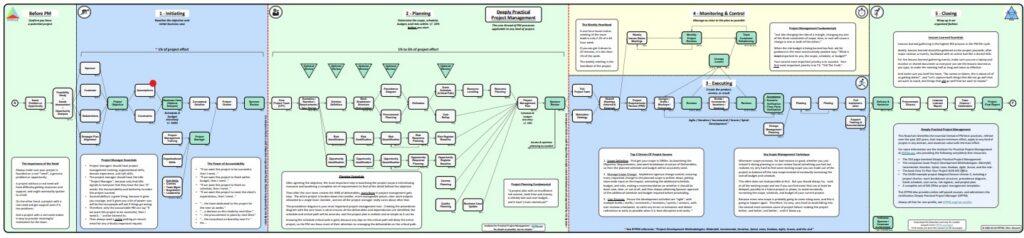
The flowchart effectively reinforces many core project management disciplines that organizations frequently neglect, including:
- scope definition,
- planning rigor,
- sponsor accountability,
- risk management,
- schedule development,
- structured execution.
From a project management perspective, the framework succeeds in simplifying many best practices into a usable operational model.
However, there are still important project management gaps that limit its effectiveness for larger, faster-moving, and more organizationally complex environments.
Strengths of the Project Management Framework
Strong Emphasis on Scope Definition
 One of the strongest elements of the framework is the emphasis on:
- requirements,
- project objectives,
- work breakdown structures,
- planning activities,
- scope baselining.
Many projects fail because organizations attempt to execute work before defining:
- what success looks like,
- what work must actually be completed,
- who owns the work,
- how progress will be measured.
The framework correctly identifies scope definition as foundational to project success.
This reduces:
- rework,
- confusion,
- stakeholder conflict,
- uncontrolled change.
Excellent Focus on Planning Discipline
The framework appropriately emphasizes:
- precedence diagrams,
- scheduling,
- cost rollups,
- resource planning,
- procurement planning,
- communications planning.
This is important because poor planning leads to unrealistic commitments that later become organizational emergencies.
The framework correctly reinforces:
planning is not administrative overhead; planning reduces uncertainty- or at the very least, makes one aware of the uncertainty.
This is one of the strongest areas with minimal project management gaps.
Practical Governance Structure
The sponsor review and approval structure is highly valuable.
Many organizations suffer from:
- unclear authority,
- weak escalation paths,
- conflicting stakeholder direction,
- decision latency.
The framework reinforces:
- sponsor accountability,
- formal approvals,
- governance checkpoints,
- triple constraint balancing.
This helps improve organizational alignment and decision clarity.
Realistic Recognition of Iterative Execution
The inclusion of:
- iterations,
- builds,
- drafts,
- prototypes,
- reviews,
reflects practical project reality.
Projects rarely execute exactly according to the original plan. Effective organizations adjust based upon:
- new information,
- stakeholder feedback,
- execution learning,
- emerging risks.
The framework acknowledges this without abandoning planning discipline.
That balance is important.
Strong Change Control Messaging
The document correctly highlights the importance of controlling scope expansion.
This is one of the most valuable sections because uncontrolled change remains one of the largest causes of:
- delays,
- budget overruns,
- resource exhaustion,
- stakeholder frustration.
The recommendation to trade scope rather than continuously expanding the project is particularly strong.
Major Project Management Gaps
Limited Emphasis on Decision Quality
One of the most important project management gaps is insufficient focus on decision-making quality.
Projects often fail because:
- decisions are delayed,
- poor assumptions are accepted,
- leaders override evidence,
- bad data is normalized,
- optimism bias dominates execution.
The framework discusses governance, but it does not sufficiently address:
- decision latency,
- executive bias,
- escalation failure,
- organizational politics,
- pressure-driven decision making.
These issues are often larger project threats than scheduling mechanics.
Metrics and Monitoring Need Expansion
The framework mentions reviews and status meetings, but stronger emphasis is needed on:
- leading indicators,
- lagging indicators,
- forecast accuracy,
- schedule confidence,
- risk burn-down,
- resource loading trends,
- issue aging,
- defect containment,
- milestone health.
Many organizations mistake reporting activity for understanding project health.
A modern project management framework should emphasize:
meaningful metrics over decorative dashboards.
Organizational Dynamics Are Underrepresented
Projects are executed by people inside organizations, not flowcharts.
The framework lightly references:
- leadership,
- communication,
- motivation,
- soft skills,
but does not go deeply enough into:
- silo behavior,
- conflicting priorities,
- resource contention,
- psychological safety,
- accountability avoidance,
- political behavior,
- leadership misalignment.
Many project failures are organizational failures disguised as scheduling failures.
This is one of the most important gaps in the project management framework.
Risk Management Needs Greater Depth
The framework includes:
- risk identification,
- qualification,
- quantification,
- response planning.
However, the treatment remains relatively traditional.
Modern project management requires stronger discussion around:
- uncertainty,
- assumptions,
- cascading risks,
- interdependent risks,
- residual risk,
- risk tolerance,
- decision-making under uncertainty,
- contingency consumption,
- schedule realism.
Risk management should become an active management discipline rather than a documentation exercise.
Missing Project Management Elements
 Resource Reality and Capacity Management
The framework references resource planning but does not sufficiently address:
- multitasking,
- organizational overload,
- shared resource conflicts,
- competing priorities,
- burnout,
- productivity degradation,
- management-driven interruptions.
Many schedules fail because organizations assume resources operate at 100% uninterrupted efficiency.
Effective project management requires realistic capacity planning.
Escalation and Issue Resolution
Projects frequently stall because:
- issues remain unresolved,
- decisions linger,
- accountability is unclear,
- escalation mechanisms fail.
The framework would benefit from stronger guidance around:
- issue ownership,
- escalation timing,
- executive intervention,
- response expectations,
- decision deadlines.
Projects slow dramatically when organizations tolerate unresolved problems.
Portfolio and Strategic Alignment
The framework discusses strategic alignment early but does not sufficiently address ongoing portfolio prioritization.
Organizations often:
- approve too many projects,
- overload teams,
- shift priorities constantly,
- dilute focus,
- spread expertise too thin.
Successful project management requires continuous prioritization discipline at the organizational level.
 Lessons Learned Integration
The lessons-learned section is valuable, but it should extend beyond project closure.
Lessons learned should occur:
- throughout execution,
- after major milestones,
- after failures,
- after recoveries,
- after critical decisions.
Organizations improve faster when learning becomes continuous rather than retrospective.
What Needs Expanded
Executive Behavior and Leadership Pressure
One of the most overlooked realities of projects is executive pressure.
Projects are often destabilized by:
- unrealistic delivery expectations,
- reputation concerns,
- bonus structures,
- schedule optimism,
- political visibility,
- emotional commitment to deadlines.
The framework should discuss:
- managing upward,
- communicating uncomfortable truths,
- evidence-based forecasting,
- resisting schedule fantasy.
Strong project management requires disciplined truth-telling.
Communication Quality
Communication planning exists, but communication effectiveness needs deeper emphasis.
Important missing areas include:
- communication clarity,
- information distortion,
- dashboard oversimplification,
- hidden risk reporting,
- escalation transparency,
- stakeholder expectation management.
Many organizations unintentionally create:
- “green status culture,”
where bad news is suppressed until recovery becomes impossible.
Schedule Confidence and Forecasting
 Schedules should not merely exist; they should have confidence levels.
The framework would benefit from discussion around:
- schedule uncertainty,
- confidence intervals,
- probabilistic forecasting,
- dependency sensitivity,
- critical path volatility,
- schedule compression risk.
Modern project management increasingly requires forecast realism rather than static schedules.
Final Assessment
The “Deeply Practical Project Management” framework succeeds as a highly practical introduction to disciplined project execution. It effectively emphasizes:
- planning rigor,
- scope management,
- governance,
- sponsor accountability,
- structured execution,
- practical communication.
The framework is strongest where many organizations are weakest:
- defining scope,
- planning realistically,
- managing change,
- maintaining accountability.
However, important project management gaps remain in:
- decision quality,
- organizational behavior,
- leadership pressure,
- metrics,
- forecasting,
- escalation management,
- portfolio prioritization,
- uncertainty management,
- communication transparency.
The framework provides strong project management fundamentals, but modern organizations also require deeper focus on:
- organizational dynamics,
- behavioral risk,
- execution realism,
- data quality,
- leadership discipline,
- meaningful measurement.
Ultimately, projects rarely fail because teams cannot create schedules.
Projects fail because organizations struggle to:
- make realistic decisions,
- communicate honestly,
- manage uncertainty,
- maintain focus,
- align priorities,
- confront emerging problems early.

For more information, contact us:
The Value Transformation LLC store.
Follow us on social media at:
Amazon Author Central https://www.amazon.com/-/e/B002A56N5E
Follow us on LinkedIn: https://www.linkedin.com/in/jonmquigley/
https://www.linkedin.com/company/value-transformation-llc
Follow us on Google Scholar: https://scholar.google.com/citations?user=dAApL1kAAAAJ
