


The Model Didn’t Age. The Product Did.
By Jon M. Quigley
This post originates from my time at Automotive Testing Expo in Novi, Michigan. I want to thank Automotive Testing Technology International for inviting me to do a fireside chat and to serve as moderator for some of the chats. The topics were enlightening, and you will likely see a flurry of blog posts by me; my notebook is full of topics I found interesting. This one comes from the discussions about vehicle stability in light of autonomous or semi-autonomous driving coupled with shifting left. If you are in product development, you likely know this means doing more design evaluation earlier.
When Simulation No Longer Matches Reality
I’ve spent years working with automotive and embedded systems development, testing, and verification. One recurring challenge is the gap between what our models predict and what products actually do over time.
Simulation is a powerful tool, but models approximate reality. Non-linearities make prediction difficult. Aging makes those non-linearities a moving target. Besides being difficult to model at t=0, aging often depends on the stimuli the product or component is subjected to. This stack-up of variability cannot be known definitively; it is not fully deterministic.
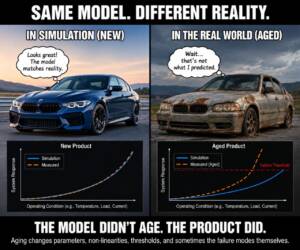
How Product Aging Changes Nonlinear System Behavior
Battery resistance changes. Sensors drift. Connections degrade. Materials fatigue. More importantly, these changes can interact, shifting operating thresholds and introducing failure modes that weren’t evident when the product was new.
A simulation that correlates well with a new product may become increasingly inaccurate as that product ages.
Why Model Validation Must Account for Product Aging
Are we validating our models against the product as designed, or against how it will behave throughout its useful life?
Product aging changes the parameters, nonlinear responses, and operating thresholds that determine system behavior. A simulation that accurately predicts a new product’s performance may become increasingly unreliable as batteries degrade, sensors drift, connections deteriorate, and mechanical components wear. These changes can interact, creating failure modes and performance limitations that were not apparent during initial development. Validating a model against a new product does not establish its predictive accuracy throughout the product’s useful life. Understanding how these characteristics evolve requires physical testing, accelerated aging, and pre- and post-test characterization of critical system attributes.
Digital twins offer an opportunity to extend model validation beyond initial product development by incorporating operating conditions, measured performance, degradation mechanisms, and field data throughout the product lifecycle. However, a digital twin remains a model, subject to assumptions, uncertainty, and limitations in the available data. Its predictive value depends on how effectively it is updated and correlated with actual product behavior, including changes in nonlinearities and interactions between aging mechanisms. The objective is not simply to predict how a product performs when new, but to anticipate how its behavior, performance margins, and failure risks evolve throughout its useful life.
Connecting Simulation, Accelerated Aging, and Physical Testing
 Simulation, sensitivity analysis, accelerated aging, and physical testing must inform one another. We need to challenge our assumptions, not simply confirm our predictions.
Passing a simulation does not mean understanding the system.
Simulation, accelerated aging, and physical testing should operate as an interconnected process rather than independent verification activities. Simulation helps identify critical parameters, predict system responses, and explore operating conditions, while accelerated aging exposes products to stresses designed to reveal degradation mechanisms and performance changes over time. Physical testing provides the evidence needed to challenge assumptions, evaluate model accuracy, and identify unexpected nonlinearities or failure modes. Pre- and post-test characterization helps quantify changes in key attributes, providing data to refine models and improve predictions throughout the product lifecycle. However, accelerated aging must also be evaluated to ensure that the imposed stresses produce degradation mechanisms representative of actual service conditions. The objective is a continuous cycle of prediction, testing, measurement, comparison, and model refinement—not simply demonstrating that a simulation agrees with a test, but understanding where, why, and under what conditions that agreement breaks down.
Passing Simulation Is Not the Same as Understanding the System
I’ve spent years working with automotive and embedded systems development, testing, and verification. One recurring challenge is understanding how product aging and simulation model validation interact. A model that accurately predicts a new product’s behavior may become increasingly unreliable as materials degrade, sensors drift, and nonlinear system responses change over time.
Simulation is a powerful tool, but models approximate reality. Non-linearities make prediction difficult. Aging makes those non-linearities a moving target.

For more information, contact us:
The Value Transformation LLC store.
Follow us on social media at:
Amazon Author Central https://www.amazon.com/-/e/B002A56N5E
Follow us on LinkedIn: https://www.linkedin.com/in/jonmquigley/
https://www.linkedin.com/company/value-transformation-llc
Follow us on Google Scholar: https://scholar.google.com/citations?user=dAApL1kAAAAJ
