


A design review should be an engineering discussion, not a feeding frenzy.
by Jon M. Quigley
Effective design reviews start long before the actual review. Throughout my years working in automotive engineering and product development, I’ve participated in countless design reviews, some highly structured and others relatively informal.
Whether the review is a formal Design Failure Mode and Effects Analysis (DFMEA), a drawing review, an architecture assessment, or an informal discussion among engineers, the objective remains the same: identify weaknesses, challenge assumptions, evaluate risks, and improve the design before those problems become expensive.
Unfortunately, not every design review accomplishes this.
The Price of Entry
I used to tell engineering teams that the price of entry into a design review was a marked-up artifact.
That artifact might be an engineering drawing, schematic, block diagram, process flowchart, specification, system drawing, interface specification, or another representation of the design under consideration.
The expectation was straightforward: review the material before the meeting, think critically about what you see, and arrive prepared to discuss your observations.
Simply attending the meeting and seeing the design for the first time was not adequate preparation.
The design review begins before anyone enters the conference room.
Preparation Is Engineering Work
Effective design reviews require time. Engineers need sufficient opportunity to examine the design, understand its requirements and interfaces, identify potential failure modes, and consider alternative approaches.
This preparation must be part of the project schedule, not something squeezed between other assignments.
Distributing a 50-page drawing package the afternoon before a review and expecting meaningful feedback the next morning is not a recipe for success.
For a structured DFMEA, preparation includes examining functions, failure modes, effects, causes, and existing prevention and detection controls. For less formal reviews, the same critical thinking applies, even without the structured worksheets.
The difference is the format, not the need for engineering discipline.
Constructive Criticism, Not a Feeding Frenzy
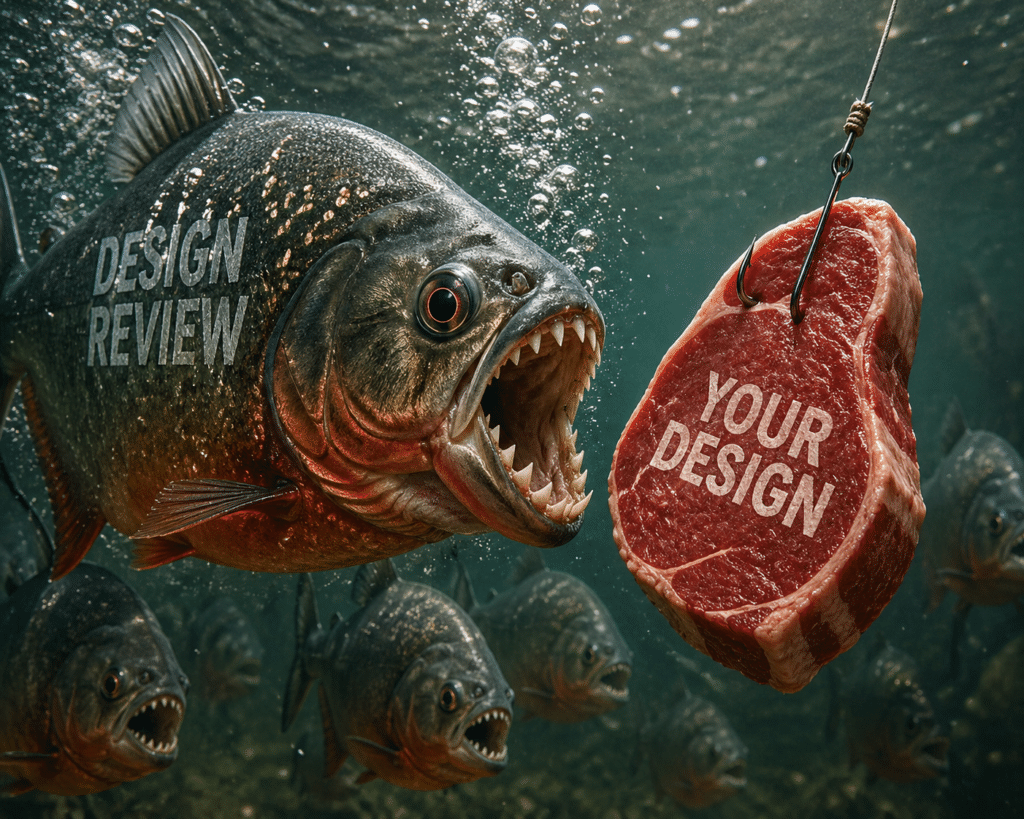
The image of piranhas attacking a design may be entertaining, but it illustrates another problem.
Design reviews should challenge the design, not attack the designer.
A successful review creates an environment where engineers can question assumptions, identify deficiencies, explore interfaces, and discuss uncertainties without turning the meeting into a contest over who can find the most mistakes.
The purpose is not to demonstrate how clever the reviewers are. It is to improve the product.
That also means documenting observations, assigning actions, resolving concerns, and verifying that changes address the identified risks. Without follow-through, even an excellent review becomes little more than an interesting conversation.
 Better Reviews, Better Products
Design reviews are among the most cost-effective opportunities to identify problems before they become embedded in prototypes, tooling, software, manufacturing processes, or products delivered to customers.
But their effectiveness depends on preparation, participation, technical curiosity, and disciplined follow-through.
My rule remains: Bring a marked-up artifact to the review.
Not because every reviewer must find something wrong, but because every reviewer should arrive having invested the time to understand, question, and improve the design. Not showing a marked-up copy does not show this needed investment. The review meeting is for a pointed critique of the product or system’s weaknesses. It is not a time to start learning about the proposed product.
A design review should consume engineering problems before those problems consume the project.

For more information, contact us:
The Value Transformation LLC store.
Follow us on social media at:
Amazon Author Central https://www.amazon.com/-/e/B002A56N5E
Follow us on LinkedIn: https://www.linkedin.com/in/jonmquigley/
https://www.linkedin.com/company/value-transformation-llc
Follow us on Google Scholar: https://scholar.google.com/citations?user=dAApL1kAAAAJ
