


 Automotive Testing Expo
Well, the Automotive Testing Expo is over. My notebook is full of notes. I want to thank all who attended, especially those who spoke during the event. We had many productive conversations and made connections to continue them.
Back in my day
In the mid-1990s, I worked for a company developing tire pressure monitoring systems, where I met Fred. Before that, I was a product development engineer, designing and delivering industrial hardware and software industrial control systems. This position let me see the entire product delivery process while still handling technical portions of the work, and that expanded as my career grew.
A product can pass a test and still come out changed. Contact resistance may increase, sensor accuracy may drift, performance may erode, or battery capacity may decrease, even as the product continues to meet its requirements. In fact, the battery paper we are working on explores this impact.
Pre-test and post-test characterization helps reveal these changes. Instead of asking only whether the product survived, we ask: What changed, how much, and what does that suggest about aging and remaining performance margin?
Establish the Baseline
Before exposure, measure attributes associated with the product’s functions and plausible failure mechanisms. These might include current consumption, insulation resistance, response time, mechanical strength, battery capacity, or thermal performance.
Repeat these measurements under comparable conditions after exposure. Record product configuration, measurement uncertainty, and recovery time so setup differences or temporary effects aren’t mistaken for permanent deterioration.
Choose a Test Flow That Fits the Question
We set up specific tests, especially early, to explore product attributes or capability. This is not really Design Verification or Validation, but engineering exploration of design or system attributes. Several ways to organize exposure and characterization exist. Each answers a different question.
| Test flow | Example sequence | What it helps investigate |
| Single exposure | Characterize → vibration → characterize | Changes associated with one exposure |
| Parallel exposures | Characterize matched groups → expose each group to a different stress → characterize | Differences between stress types with less carryover from earlier tests |
| Sequential exposures | Characterize → thermal cycling → characterize → vibration → characterize | Cumulative deterioration and possible effects of prior exposure |
| Combined stresses | Characterize → simultaneous temperature, electrical load, and vibration → characterize | Behavior under interacting stresses |
| Periodic aging checks | Characterize → operating cycles → characterize → repeat | Degradation trends, variability, and changes in rate |
| Sequence comparison | One group receives heat then vibration; another receives vibration then heat | Whether exposure order affects the outcome |
These flows involve a tradeoff. Reusing specimens captures cumulative effects but makes individual causes harder to isolate. Separate groups improve attribution but require more specimens.
This is not to suggest that we should not explore product and systems performance during testing; however, that is not easy to do. What we can say is that relying on a single approach to product testing is very limiting.
Battery Cells: An Example of a Staged Flow
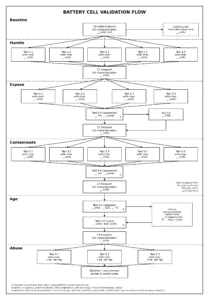
This isn’t solely about batteries, although we used this approach for a unique battery-powered vehicle component, a tire pressure monitoring system. The accompanying battery cell validation flow illustrates a staged approach, with full characterization at successive checkpoints:
- C0—Baseline: Establish initial cell attributes.
- C1—After handling tests: Measure changes following handling-related exposures.
- C2—After exposure tests: Assess additional changes following the designated environmental exposures.
- C3—After contamination tests: Examine changes following contamination-related testing.
- C4—After aging: Evaluate changes following calendar and cycle aging, supported by interim characterization.
- Abuse and teardown: Assess behavior under the specified abuse conditions, followed by physical examination.
The diagram includes branches within stages, sequential elements, and control units receiving characterization only. It therefore illustrates a family of test paths rather than one identical sequence for every cell.
Measure the Change, Then Investigate Its Meaning
Repeated characterization has a research foundation. A U.S. Department of Energy battery study interrupted life testing every four weeks to measure capacity, pulse-power performance, and impedance. NASA researchers likewise used changes in power-transistor ON-state resistance as an indicator of degradation during thermal cycling.
A before-and-after difference alone does not establish remaining service life. That requires evidence connecting the measured change to a failure mechanism and its progression under relevant operating conditions.
A passing result tells us the acceptance criteria were met. Characterization helps us understand how the product changed while meeting them.
Applying Characterization to Other Vehicle Systems
The same approach applies to vehicle mechatronics and sensors. For an electric actuator, pre-test and post-test characterization might compare operating current, output force or torque, positioning accuracy, backlash, and response time. Measurements taken before and after vibration, thermal cycling, moisture exposure, or repeated operation can reveal changes even when the actuator still completes its commanded movement. For sensors, compare offset, sensitivity, repeatability, hysteresis, and response time under controlled conditions. Checking several points across the operating range helps reveal changes that a single-point functional check could miss.
Mechanical components also benefit from this approach. Springs can be checked for changes in load at a specified deflection; bushings for stiffness and permanent deformation; bearings for running torque, clearance, and vibration; and seals for leakage under defined pressure and temperature conditions. Select attributes tied to the component’s function and expected deterioration mechanisms, then repeat the measurements at meaningful points in the test flow. The question is whether the part still works—and how its capability and margin have changed.
References
[1] C. R. Birkl and D. A. Howey, “Model identification and parameter estimation for LiFePO4 batteries,” in Proc. IET Hybrid Elect. Veh. Conf. (HEVC 2013), London, U.K., 2013, cp.2013.1889.
[2] K. Pries and J. M. Quigley, Project Management of Complex and Embedded Systems, Ensuring Product Integrity and Program Quality, Boca Raton: CRC Press, 2008.
[2] K. Rumpf, M. Naumann, and A. Jossen, “Experimental investigation of parametric cell-to-cell variation and correlation based on 1100 commercial lithium-ion cells,” J. Energy Storage, vol. 14, pp. 224–243, Dec. 2017, .est.2017.09.010.
[3] I. Zilberman, S. Ludwig, and A. Jossen, “Cell-to-cell variation of calendar aging and reversible self-discharge in 18650 nickel-rich, silicon–graphite lithium-ion cells,” J. Energy Storage, vol. 26, Dec. 2019, Art. no. 100900, .est.2019.100900.
[4] R. Ahmed et al., “Model-based parameter identification of healthy and aged Li-ion batteries for electric vehicle applications,” SAE Int. J. Altern. Powertrains, vol. 4, no. 2, Jul. 2015, 2015-01-0252.
[5] M. Naylor Marlow, J. Chen, and B. Wu, “Degradation in parallel-connected lithium-ion battery packs under thermal gradients,” Commun. Eng., vol. 3, Jan. 2024, Art. no. 2, s44172-023-00153-5.
[6] P. Dechent, S. Greenbank, F. Hildenbrand, S. Jbabdi, D. U. Sauer, and D. A. Howey, “Estimation of Li-ion degradation test sample sizes required to understand cell-to-cell variability,” Batteries Supercaps, vol. 4, no. 12, pp. 1821–1829, Dec. 2021, batt.202100148.
[7] Y. Tripathy, A. McGordon, and J. C. T. Low, “A new consideration for validating battery performance at low ambient temperatures,” Energies, vol. 11, no. 9, Sep. 2018, Art. no. 2439, en11092439.
[8] J. M. Quigley, Dictionary of Test and Verification. SAE International, ISBN: 978-1-4686-0590-7.

For more information, contact us:
The Value Transformation LLC store.
Follow us on social media at:
Amazon Author Central https://www.amazon.com/-/e/B002A56N5E
Follow us on LinkedIn: https://www.linkedin.com/in/jonmquigley/
https://www.linkedin.com/company/value-transformation-llc
Follow us on Google Scholar: https://scholar.google.com/citations?user=dAApL1kAAAAJ
